Tidal Wave Mushroom, Exploring the Strongest Magic Mushroom Strain
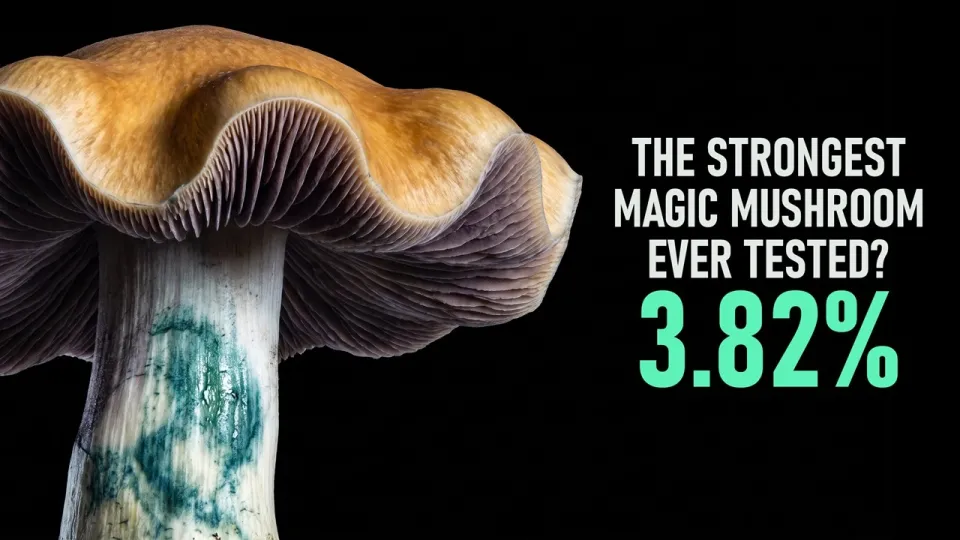
Video: The Strongest Magic Mushroom Ever Tested? Tidal Wave Mushroom
· based on the channel Shroomverse
Key takeaways
- Tidal Wave mushroom tested over four times average psilocybin potency in a 2021 competition
- Strain derived from legendary parents like Penis Envy and B+ mushrooms
- Blue bruising in mushrooms results from psilocin oxidation upon injury
- Strain names don't guarantee consistent potency due to genetic and environmental factors
- Psilocybin Cup results provide scientific data on mushroom potency and strain variations
What is the Tidal Wave Mushroom?
The Tidal Wave mushroom is a strain of Psilocybe cubensis renowned for its exceptionally high psilocybin potency. In a 2021 Psilocybin Cup competition held in Oakland, California, a bag labeled "Tidal Wave" tested at over four times the average psilocybin concentration of other entries, marking it as one of the strongest magic mushroom strains ever recorded. This strain has since become a subject of interest for both mycologists and psychonauts seeking potent psychedelic experiences. For detailed competition results and potency data, visit the Psilocybin Cup official results.
The Legendary Parentage of Tidal Wave
Tidal Wave is a hybrid strain, believed to descend from legendary parent strains such as Penis Envy and B+. Penis Envy mushrooms are famous for their dense, thick stems and high potency, while B+ is known for its large fruiting bodies and resilience. The crossing of these strains has resulted in Tidal Wave's unique characteristics: a robust physical appearance and an unusually high concentration of psilocybin and psilocin compounds. This genetic lineage contributes to both its strength and distinct morphological features.
Why Do Magic Mushrooms Turn Blue?
The blue bruising observed on Tidal Wave and other psilocybin mushrooms occurs due to a chemical reaction involving psilocin, a psychoactive compound. When the mushroom tissue is injured or bruised, psilocin undergoes oxidation, leading to the formation of blue-colored compounds. This blueing reaction is considered an indicator of active psilocybin presence, although the intensity of the blue color doesn’t directly quantify potency. Research, such as the study published in Angewandte Chemie, confirms the injury-triggered blueing mechanism as a natural defense and chemical pathway in Psilocybe species.
Understanding What a "Strain" Really Means
In mycology, a "strain" refers to a genetic variant or subtype within a species, in this case, Psilocybe cubensis. However, the term is loosely used in psychedelic mushroom culture to describe mushrooms with particular appearances or effects. Strain names like Tidal Wave, Penis Envy, or B+ do not guarantee consistent potency or effects due to genetic variability, environmental growing conditions, and cultivation methods. Scientific studies, including whole-genome analyses, reveal that even within a named strain, significant chemical and genetic diversity exists.
From Folklore to Scientific Data
While folklore and anecdotal reports praise Tidal Wave as the strongest magic mushroom strain, recent scientific efforts have started to quantify its potency. The Psilocybin Cup provides empirical data showing Tidal Wave's psilocybin content surpassing typical levels dramatically. Analytical techniques like LC-MS/MS enable researchers to measure psilocybin and psilocin concentrations precisely, validating or challenging traditional beliefs. This data-driven approach refines our understanding of the psychedelic potential and variability among different mushroom strains.
What the Potency Number Really Means
A potency number, such as the one reported for Tidal Wave, indicates the concentration of psilocybin and related compounds in the mushroom biomass. However, it doesn’t directly translate to subjective strength or effects experienced by users, which are influenced by dosage, individual physiology, and set and setting. Moreover, batch-to-batch variability means that even mushrooms labeled as Tidal Wave can differ in potency. Therefore, the strain name alone is insufficient to predict effects reliably, emphasizing the need for chemical testing and cautious use.
Useful Links
- Psilocybin Cup results and data: https://tripsitter.com/psilocybin-cup/
- Oakland Hyphae newsletter: https://oaklandhyphae.substack.com/
- Draft genome of Psilocybe cubensis: https://pmc.ncbi.nlm.nih.gov/articles/PMC8220353/
- Whole-genome atlas of Psilocybe genomes: https://f1000research.com/articles/10-961
- Variation of psilocybin and psilocin across flushes: https://pubmed.ncbi.nlm.nih.gov/7201054/
Conclusion
The Tidal Wave mushroom stands out as one of the most potent Psilocybe cubensis strains tested, with psilocybin levels exceeding four times the average in a noted competition. Its lineage, combining strains like Penis Envy and B+, contributes to its potency, but genetic and environmental factors cause variation. Blue bruising is a natural chemical reaction tied to psilocin oxidation, not a definitive measure of strength. Scientific data, such as that from the Psilocybin Cup, help clarify potency claims but caution against assuming consistent effects based on strain names alone. For more educational content on psychedelic mushrooms and mycology, consult the Shroomverse channel and explore resources like the Psilocybin Cup results linked above.
Source: The Strongest Magic Mushroom Ever Tested? Tidal Wave Mushroom · Markdown version
Questions & answers
What makes the Tidal Wave mushroom so potent compared to other strains?
Tidal Wave's potency comes from its genetic lineage, combining potent parent strains like Penis Envy and B+, resulting in higher concentrations of psilocybin and psilocin than average strains.
Why do magic mushrooms like Tidal Wave turn blue when handled?
The blue color appears due to oxidation of psilocin when the mushroom tissue is injured or bruised, a natural chemical reaction common in psilocybin-containing mushrooms.
Does the strain name guarantee the potency of the mushroom?
No, strain names such as Tidal Wave or Penis Envy indicate genetic variants but do not guarantee consistent potency because of genetic variation and environmental factors affecting chemical composition.
Where can I find reliable data on magic mushroom potency and strains?
Reliable data can be found through scientific studies and competitions like the Psilocybin Cup, which publishes detailed analyses of psilocybin content across various strains. Visit https://tripsitter.com/psilocybin-cup/ for official results.